

THEALUX
Theater and Sociability in the Duchy of Luxembourg, 1600-1815
Early modern theater and performance in the Duchy of Luxembourg is an understudied phenomenon. The traditional historical narrative binds theatrical activity in the Duchy to its 19th-century emergence as a nation-state. Cultural life in early modern Luxembourg was believed to be limited because of the Duchy’s rural geography, lack of institutions, and religious practices.
The project TheaLux (Theater and Sociability in the Duchy of Luxembourg, 1600-1815) calls into question narratives of theatrical absence in the Duchy by rewriting the history of early modern theater in Luxembourg. The story of a Luxembourg lacking theater is grounded in a complicated history of languages, definitions, and archives that requires careful and multilingual untangling. Official documents from the period are dispersed in libraries and archives across France, Belgium, Germany, Austria, the Netherlands, and Luxembourg. Essential to this project is a comprehensive analysis of materials related to theatre across several countries.
A significant outcome of the project will be a series of publications on Luxembourg, theater, and the early modern period. This will serve as an important corrective to the “absence” narrative, which excludes the Duchy from theater history, Enlightenment sociability, and, in some senses, cultural modernity. This study should reveal that Luxembourgers were not culturally repressed, uninterested subjects to foreign rulers, nor did they only understand theater in the context of national awakening. Luxembourgers, like their early modern counterparts in surrounding territories, enjoyed theater for a host of reasons, participating in a process of cultural exchange and knowledge building at a crucial moment in European history.
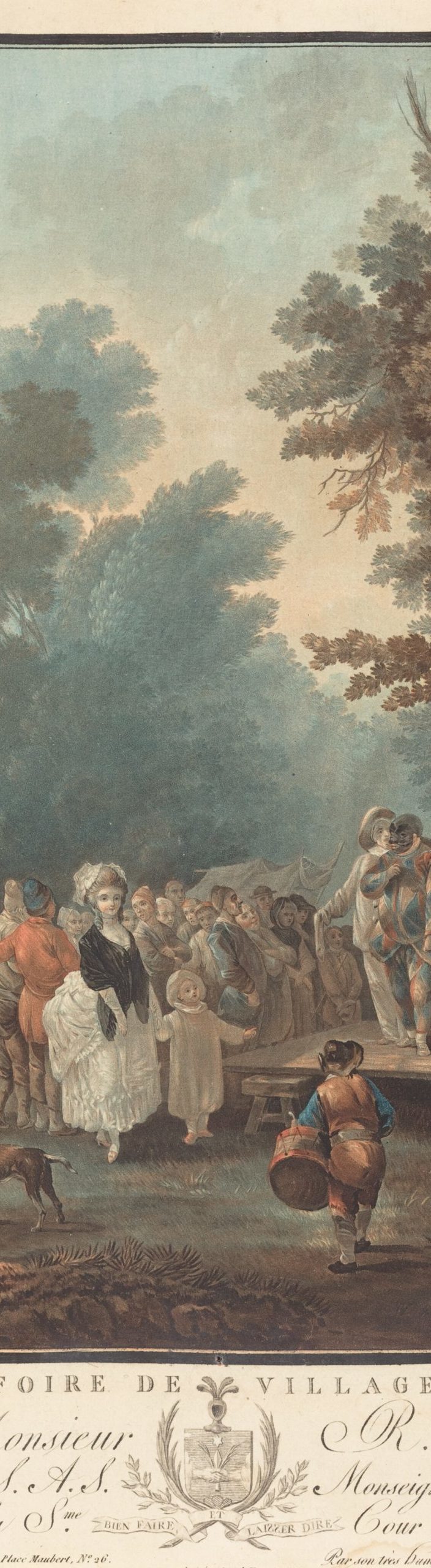
Image: Foire de Village (1788) by Charles-Melchior Descourtis after Nicolas Antoine Taunay. National Gallery (USA). Public Domain